Security Trustees for UK Social Investments
January 2026
1 Executive Summary
1.1 Feasibility of a Specialist Security Trustee Service for UK Social Investments
This research report investigates the necessity and feasibility of a specialized security trustee service tailored for the UK social investment market, exploring whether the current reliance on “accidental” investor-trustees or “impact-blind” commercial providers is sustainable.
The Core Problem
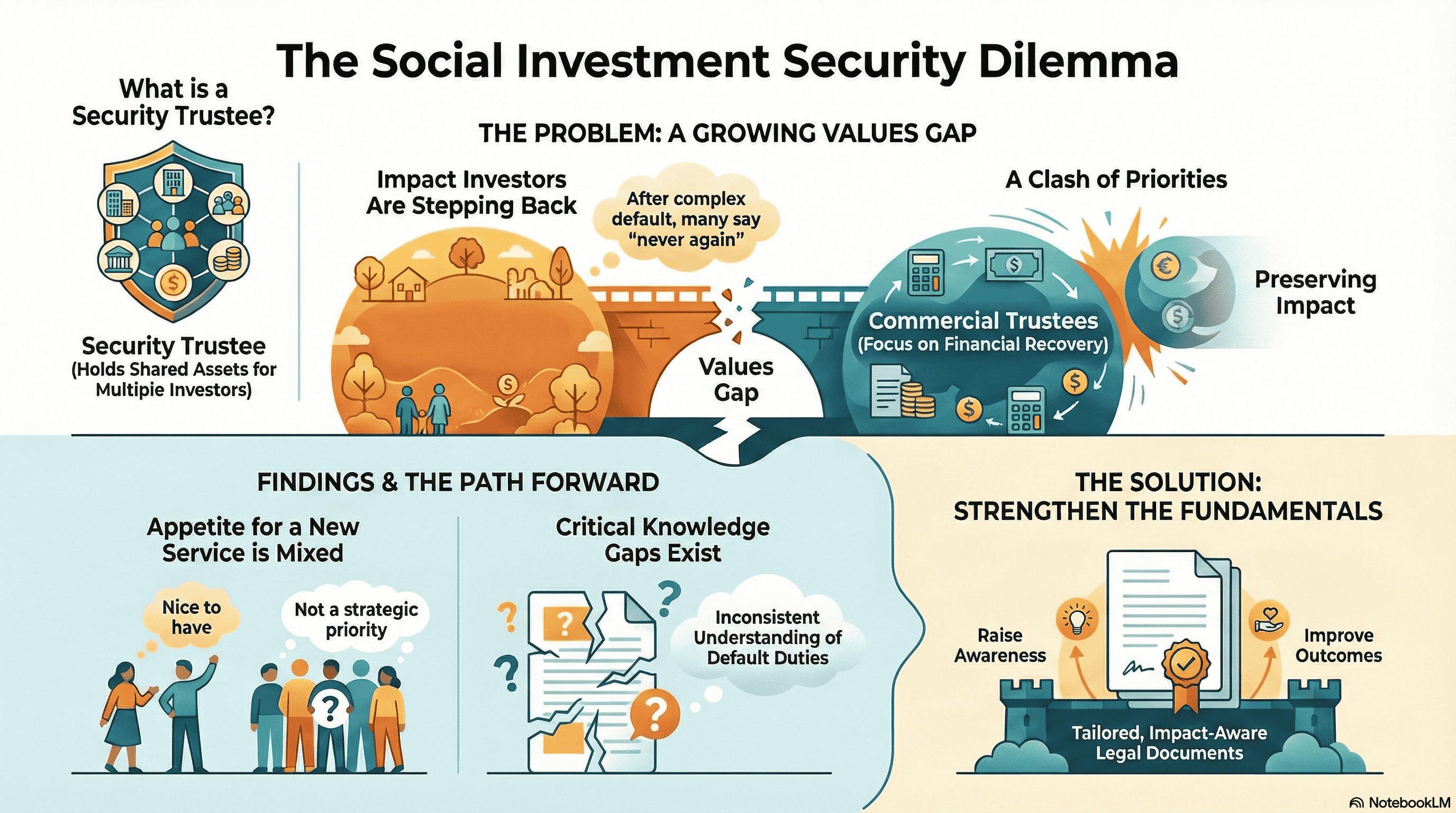
A security trustee is appointed to hold and manage security interests on behalf of multiple investors in syndicated loans or bond issuances. Historically, lead social investors frequently volunteered for this role to save costs; however, this practice is in sharp decline. Investors who have navigated the legal and administrative complexities of a default scenario often adopt a “never again” stance, leading to a shortage of mission-aligned trustees.
The alternative – commercial third-party providers – presents several challenges:
- Lack of Alignment: They often lack familiarity with impact goals and may be associated with activities that social investors find objectionable.
- Fiduciary Conflict: Their primary duty is traditionally interpreted as maximizing financial recovery, which may clash with social investors’ desires to pursue “workout” solutions that preserve social impact at the expense of a slower or lower financial return.
- Passivity and Cost: They are often viewed as expensive “insurance policies” that remain passive until a crisis occurs, at which point they may be “paralyzed with indecision” and reliant on costly external advisors.
Key Research Insights
- No Specialist Provider Exists: There is currently no known UK-based provider offering a security trustee service specifically aligned with the values and unique characteristics of social and impact investing.
- Mixed Market Understanding: While social investors generally grasp the purpose of a security trustee, there is significant confusion regarding specific legal responsibilities, particularly the fact that the role is strictly administrative and holds no advisory function.
- Documentation Friction: Current legal arrangements are often based on generic, “off-the-shelf” commercial templates inserted late in the deal process. These are rarely tailored to reflect the mission-driven purpose of the borrower or the motivations of the investors, leading to complexity during defaults.
- Evolving Market Structures: Some parts of the market are shifting away from syndicated structures toward independent, larger investments to avoid the need for coordination, while trusts and foundations continue to rely on co-investment models.
Market Demand and Governance
The research found no universal or immediate demand for a dedicated specialist entity. While stakeholders generally regard a specialist service as a “nice to have,” it is not currently viewed as a strategic priority. Opinion on the governance model is divided; some favour a service embedded within the social sector to ensure empathy for beneficiaries, while others (particularly advisors) advocate for independence to avoid “implied conflicts of interest” when a trustee is also an investor.
Strategic Recommendations
Rather than large-scale reform or the immediate establishment of a new entity, the report suggests several targeted improvements to strengthen market fundamentals:
- Tailored Documentation: Develop sector-specific legal templates that reflect social investment values and explicitly outline expectations in default scenarios.
- Education and Guidance: Raise awareness of the security trustee’s role through clearer, sector-wide guidance to reduce friction during deal-making.
- Specialist Agents: Explore the use of specialist agents – experienced in defaults and familiar with social impact – who can support investors during complex workouts without necessarily fulfilling the formal, mechanical role of a trustee.
Conclusion
While a dedicated service would remove a significant “pain point,” there are challenges with setting one up, that would require creative solutions.