3 Survey Results
3.1 Overview
The survey was available from 21 August 2025 to 29 September 2025, and was publicised through direct e-mail and via LinkedIn, where posts on the subject received 1,576 impressions. A copy of the survey can be found in the appendix. We received a total of 19 completed surveys.
Below, each survey question is presented with a corresponding visualisation and a brief explanation of what the chart shows.
3.2 Survey respondents - who took part?
3.2.1 Which of the following best describes your organisation?
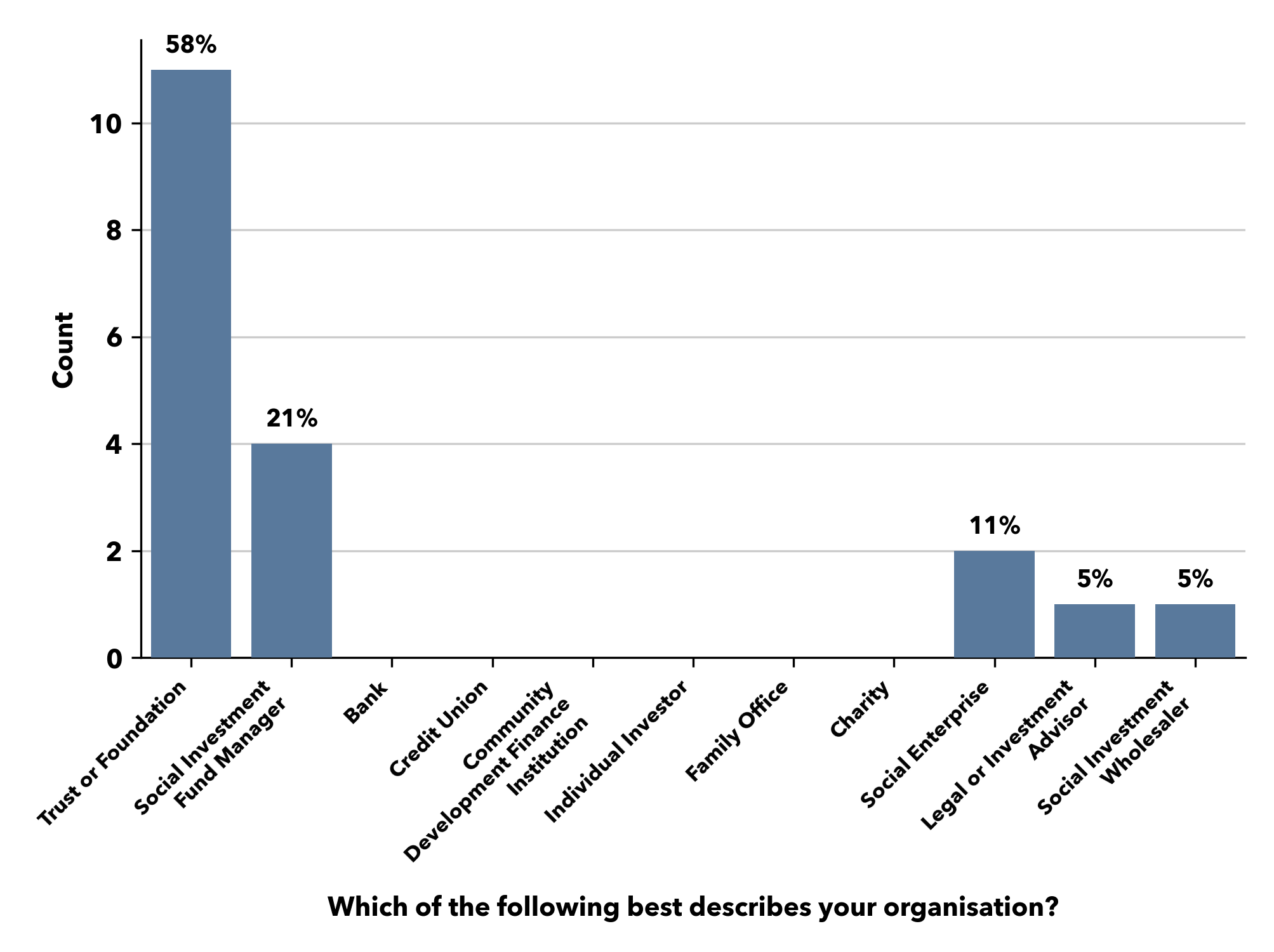
This chart shows the types of organisations represented in the survey, highlighting the diversity of participants in the social investment market.
Although we sought to get input from a wide range of market participants, the vast majority of respondents were from trusts and foundations (61%). Other types of organisations represented were social investment fund managers, social enterprises, and legal or investment advisors.
3.2.2 How many employees does your organisation have?
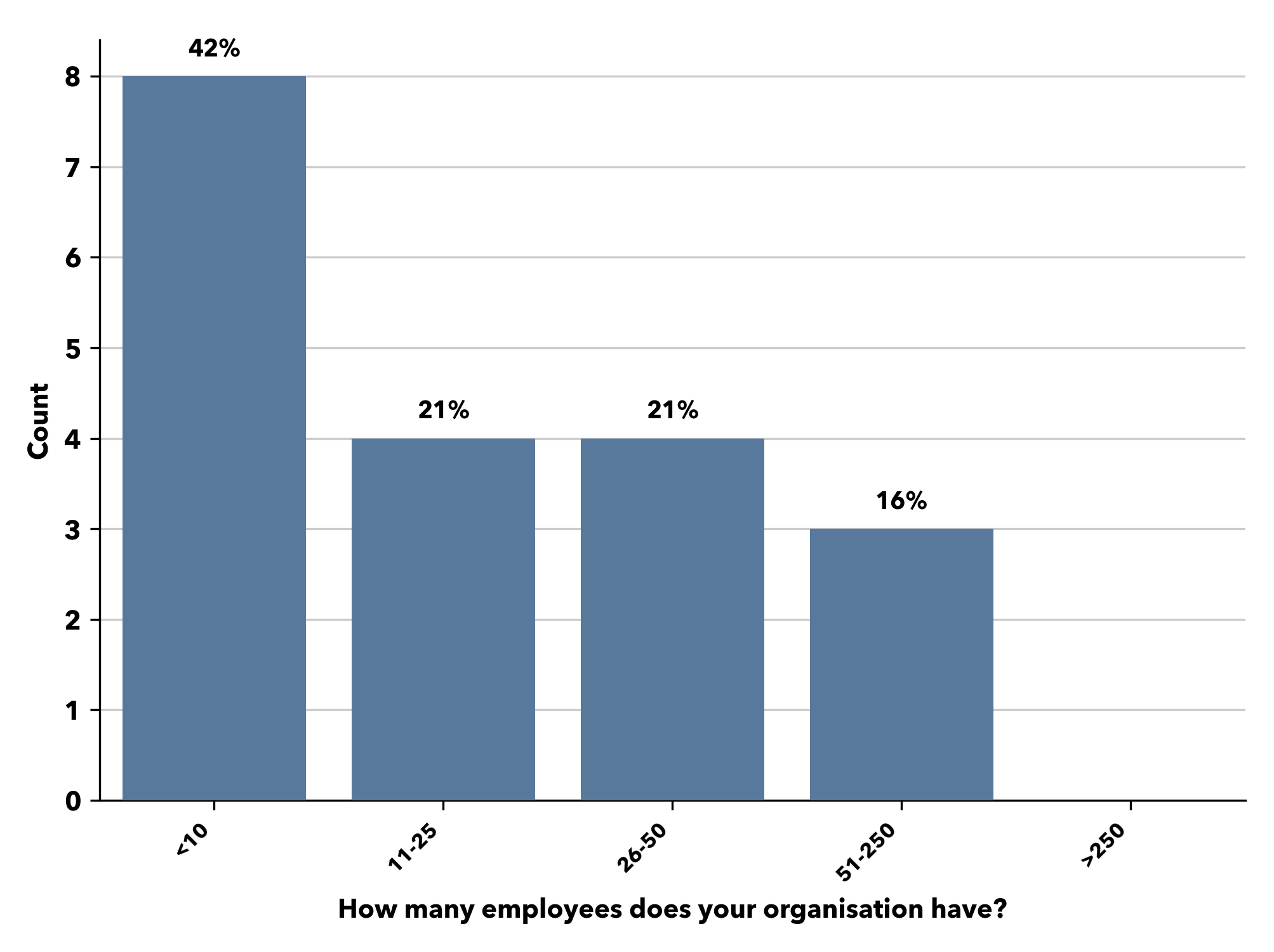
This visualisation illustrates the size distribution of organisations, providing context for the scale of social investment activity. This question was not available to people who identified as individual investors.
3.2.3 Approximately, what percentage of the total employees focus on social investment in some capacity?
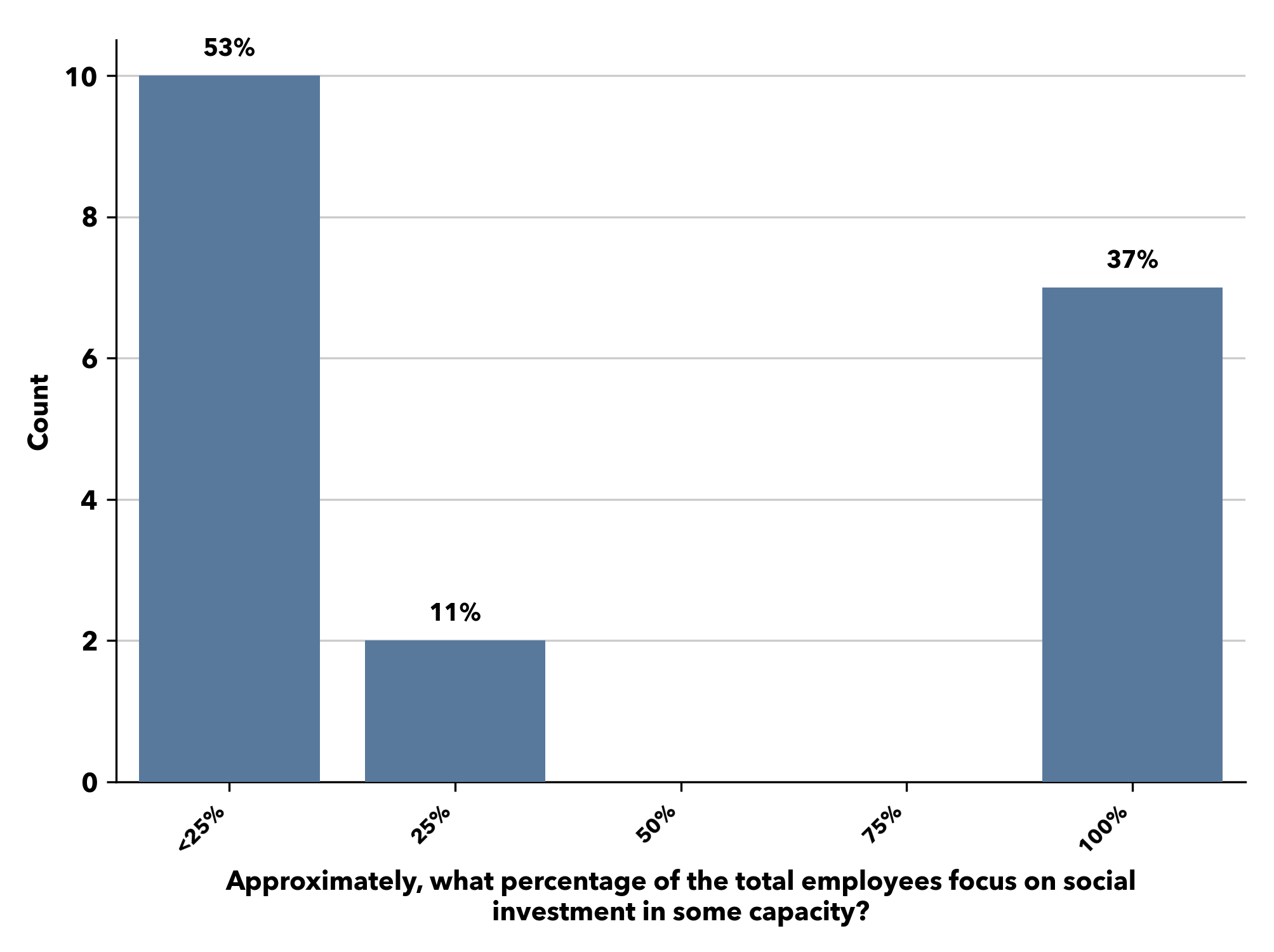
This chart shows the proportion of staff involved in social investment, indicating organisational commitment to this area.
3.2.4 Would you describe social investment as the main activity undertaken by your organisation?
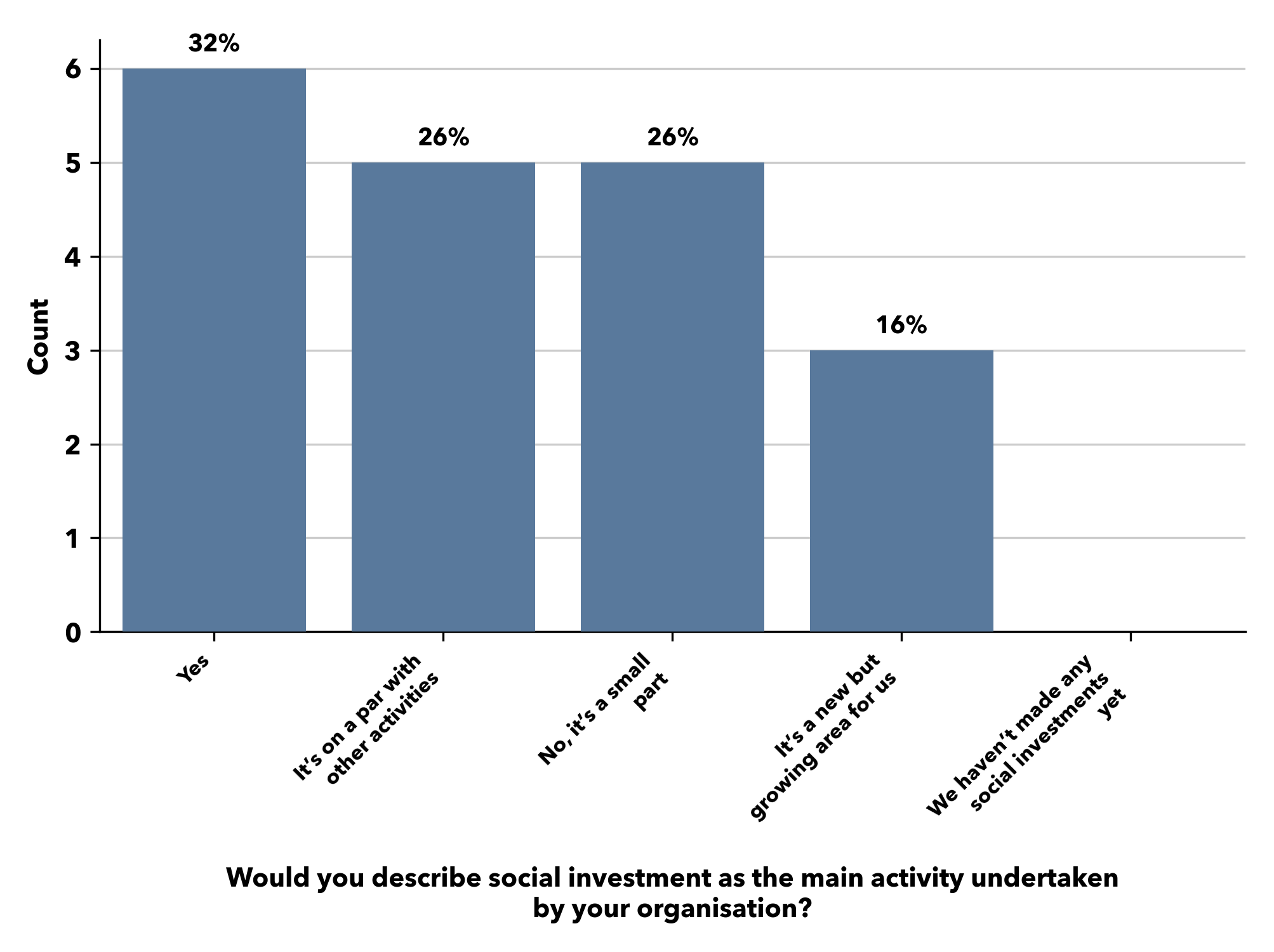
This visualisation reveals whether social investment is a core, equal, or minor activity for respondents.
3.3 Types of social investments and experience
3.3.1 Which of the following best describes the type of investments your organisation tends to consider
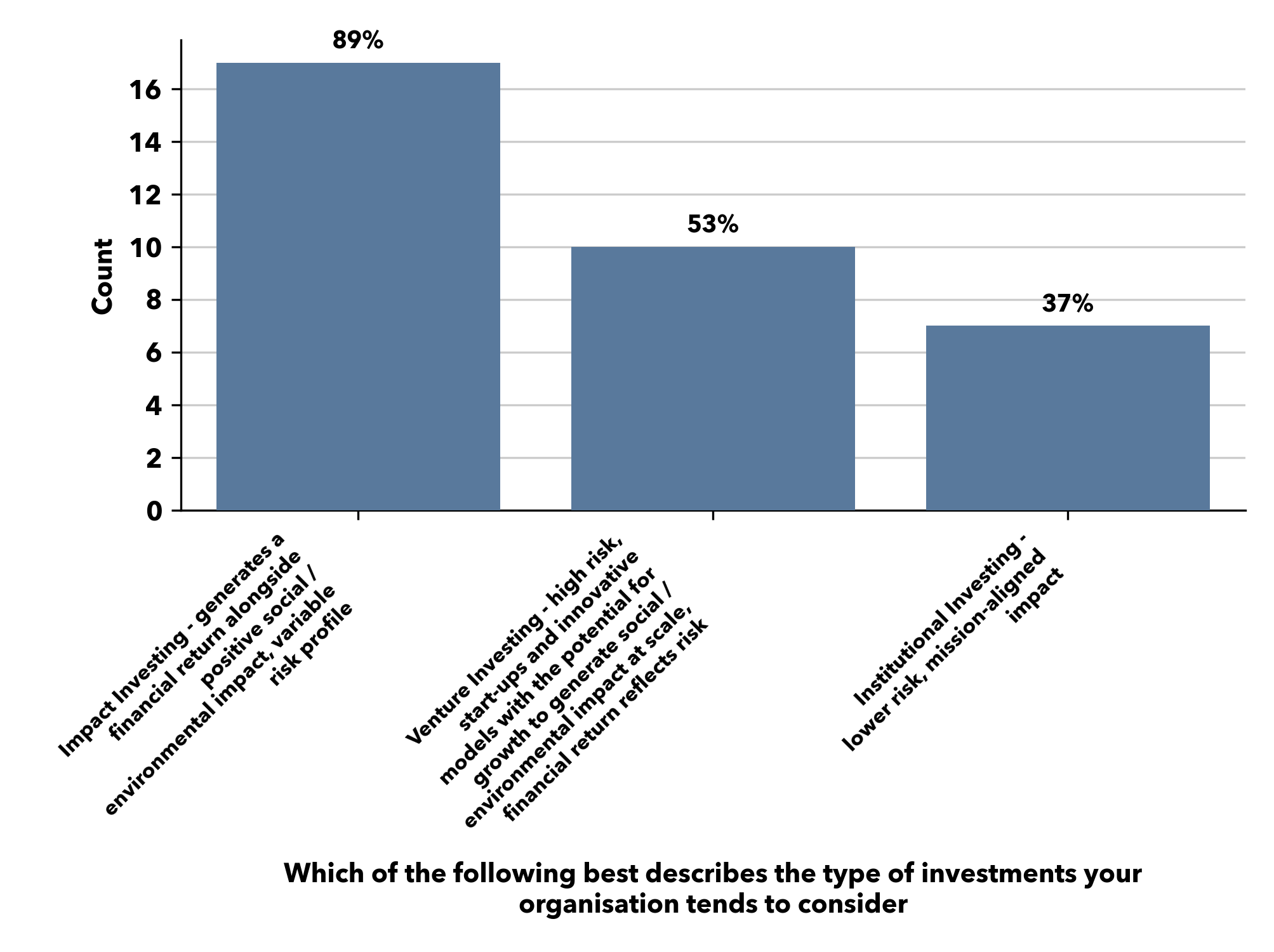
This chart shows the types of investments considered, such as impact, venture, or institutional investing. Respondents could pick multiple answers.
3.3.2 What size of social investment would your organisation typically consider?
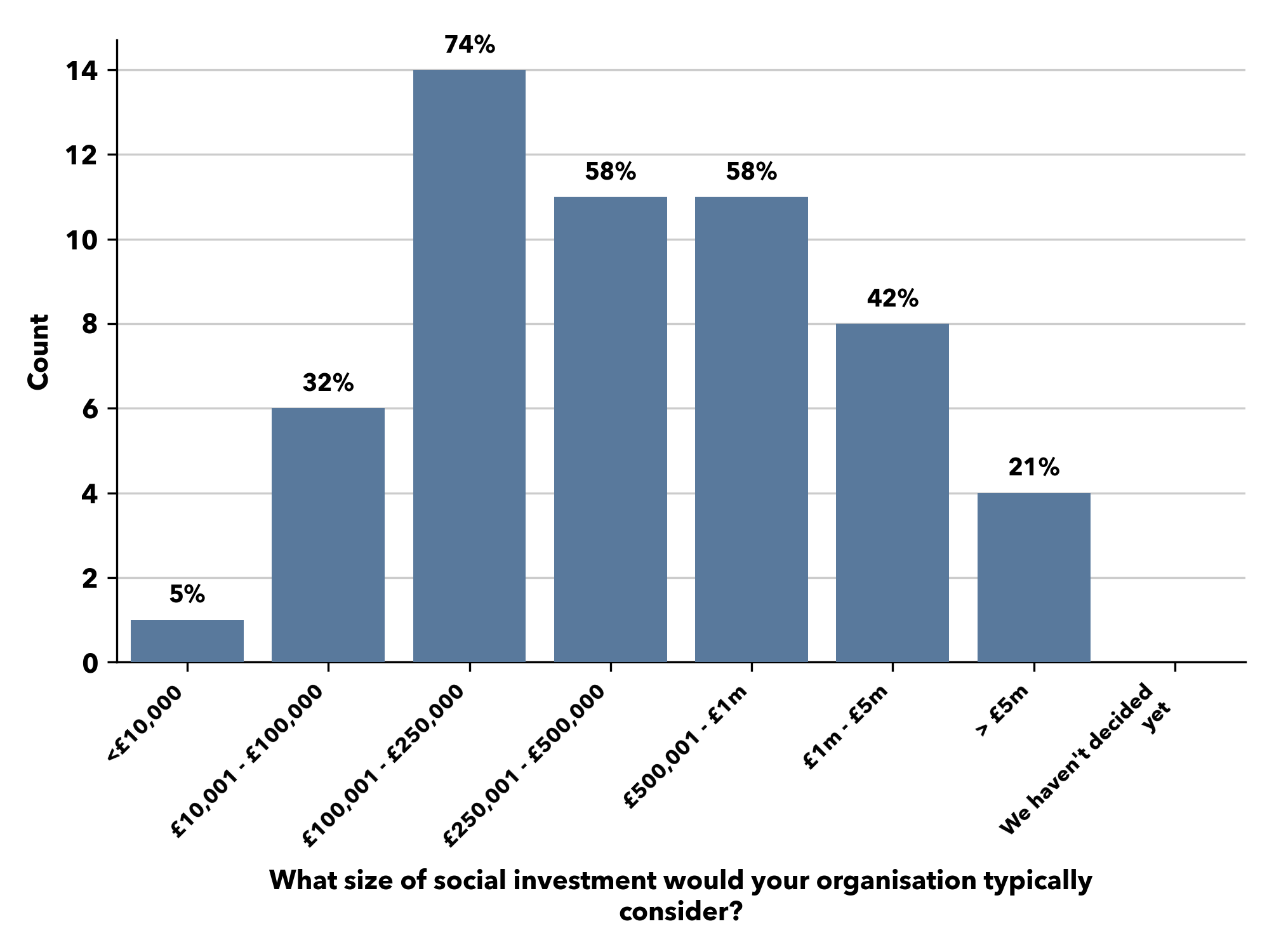
This visualisation displays the typical investment sizes, highlighting the financial scale of activity. Respondents could pick multiple answers.
3.3.3 Approximately how many social investments has your organisation made/received/advised on to date?
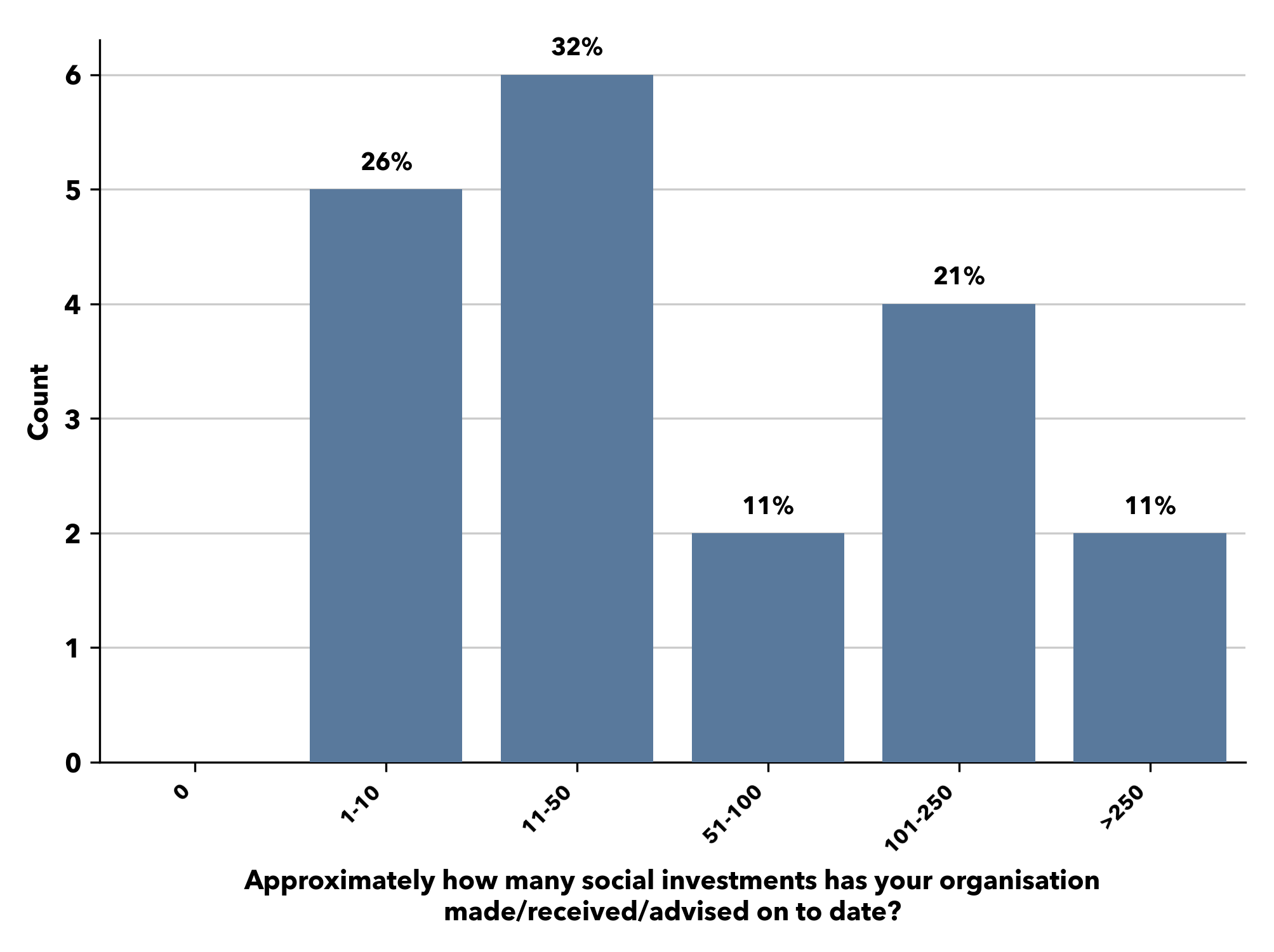
This chart shows the experience level of organisations in social investment.
3.3.4 How would you describe your tolerance for financial risk?
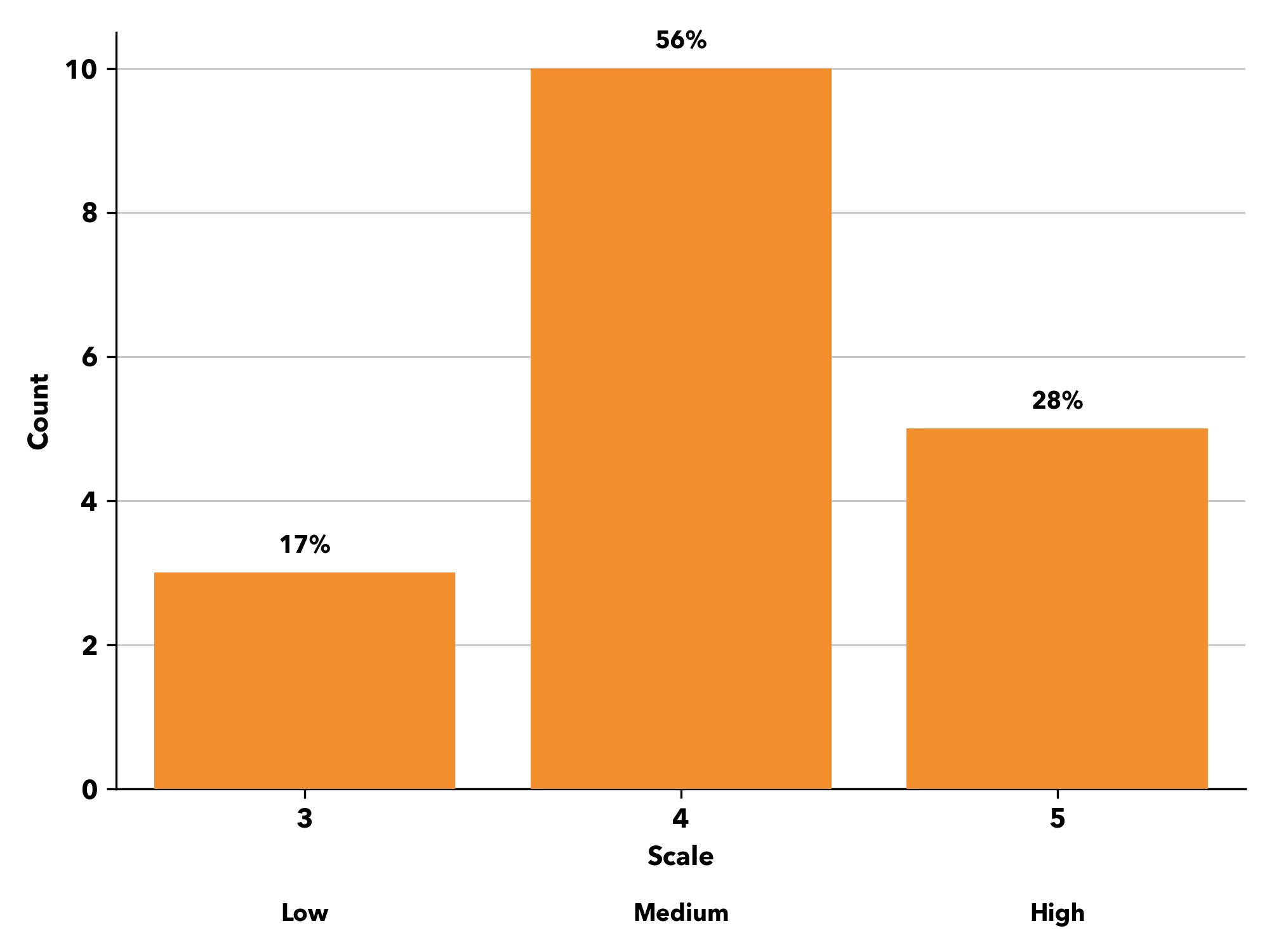
This visualisation illustrates the risk appetite of respondents in the context of social/impact investments. This question was not available to “Legal or Investment Advisor” respondents.
3.3.5 What type of entities does your organisation tend to invest in or would consider investing in?
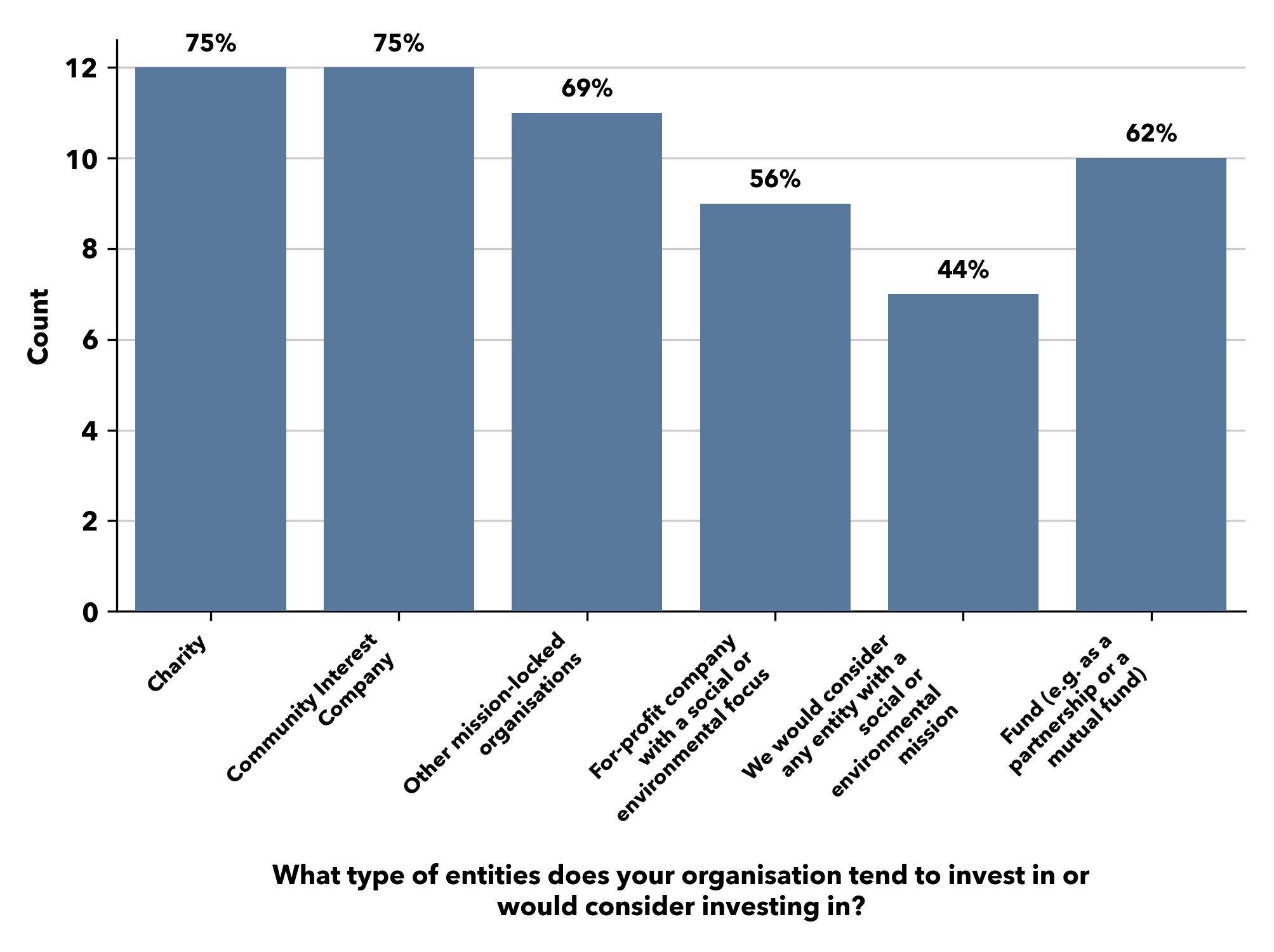
This chart shows the types of entities considered for investment, such as charities, CICs, or for-profit companies with a social focus. This question was not available to respondents who classified themselves as “Charity”, “Social Enterprise”, or “Legal or Investment Advisor”.
3.3.6 What type of social investments would your organisation consider?
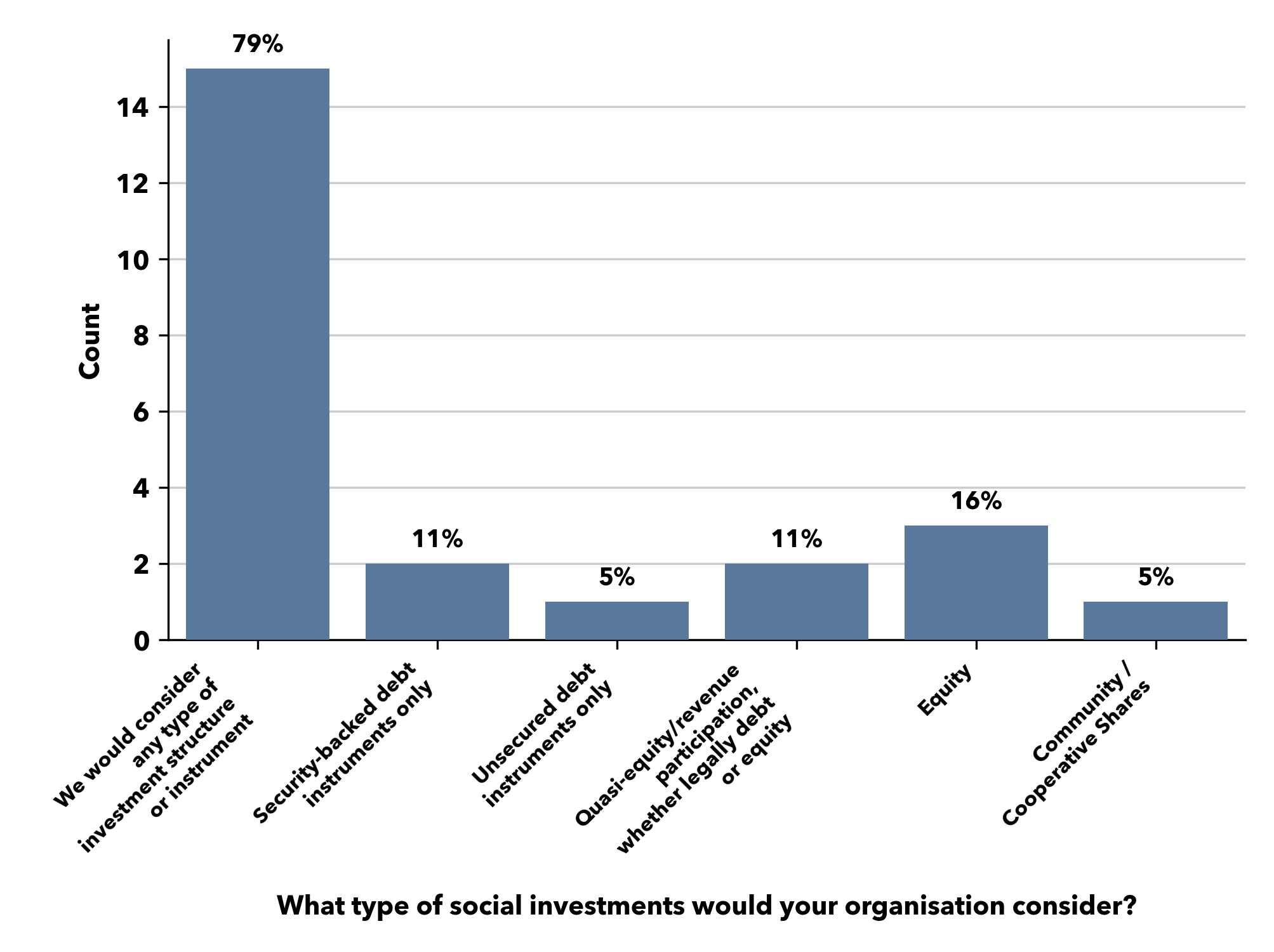
This visualisation displays the range of investment structures and instruments considered by respondents.
3.4 Security trustees - understanding and experience
3.4.1 How familiar are you with the concept of a security trustee in a social investment context?
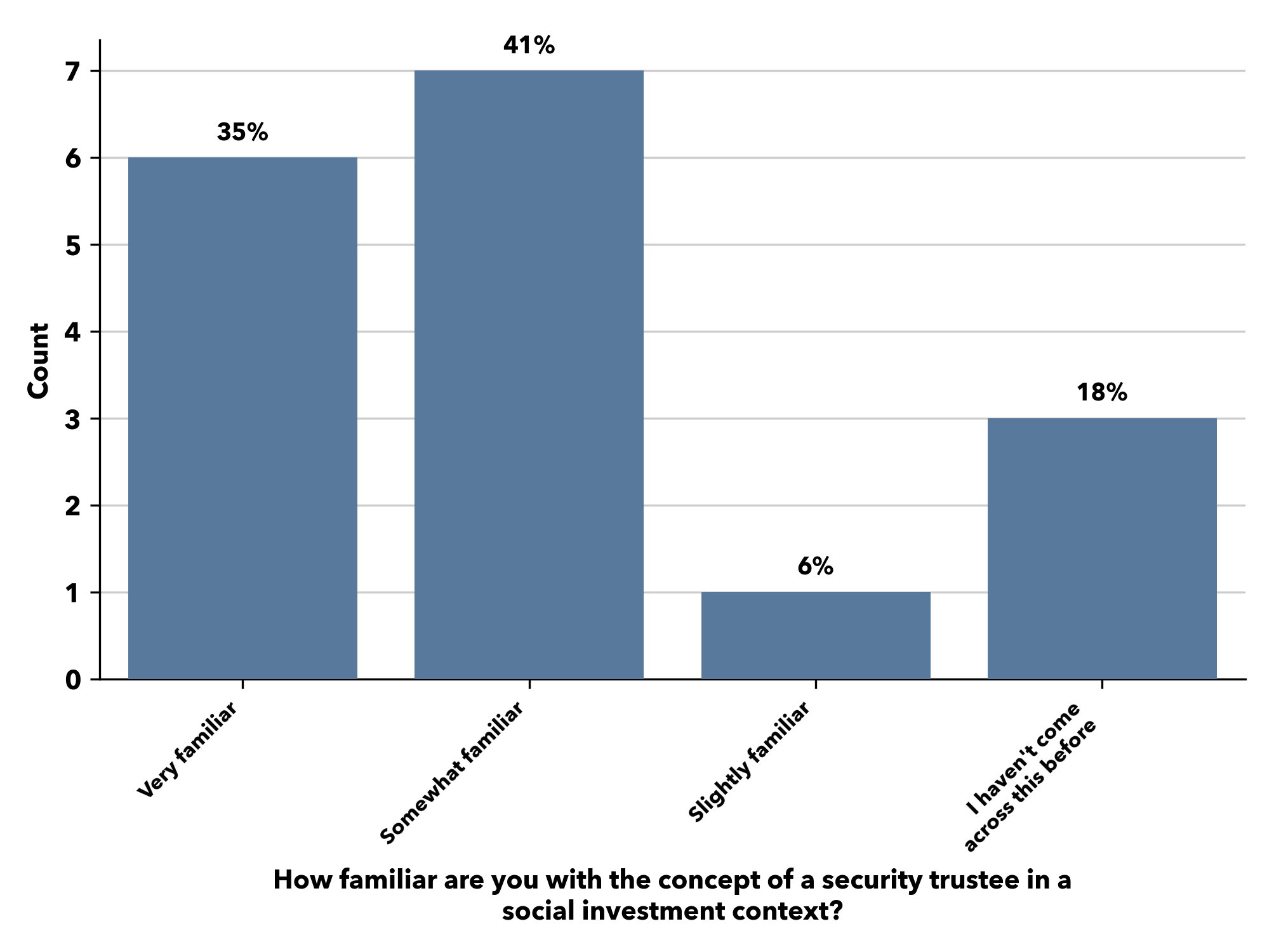
This chart shows the claimed level of familiarity with security trustees among participants. This question was only made available to respondents who said they would consider an investment type that might require a security trustee.
3.4.2 How confident do you feel that you (and your organisation) understand the role and responsibilities of a security trustee in a default scenario?
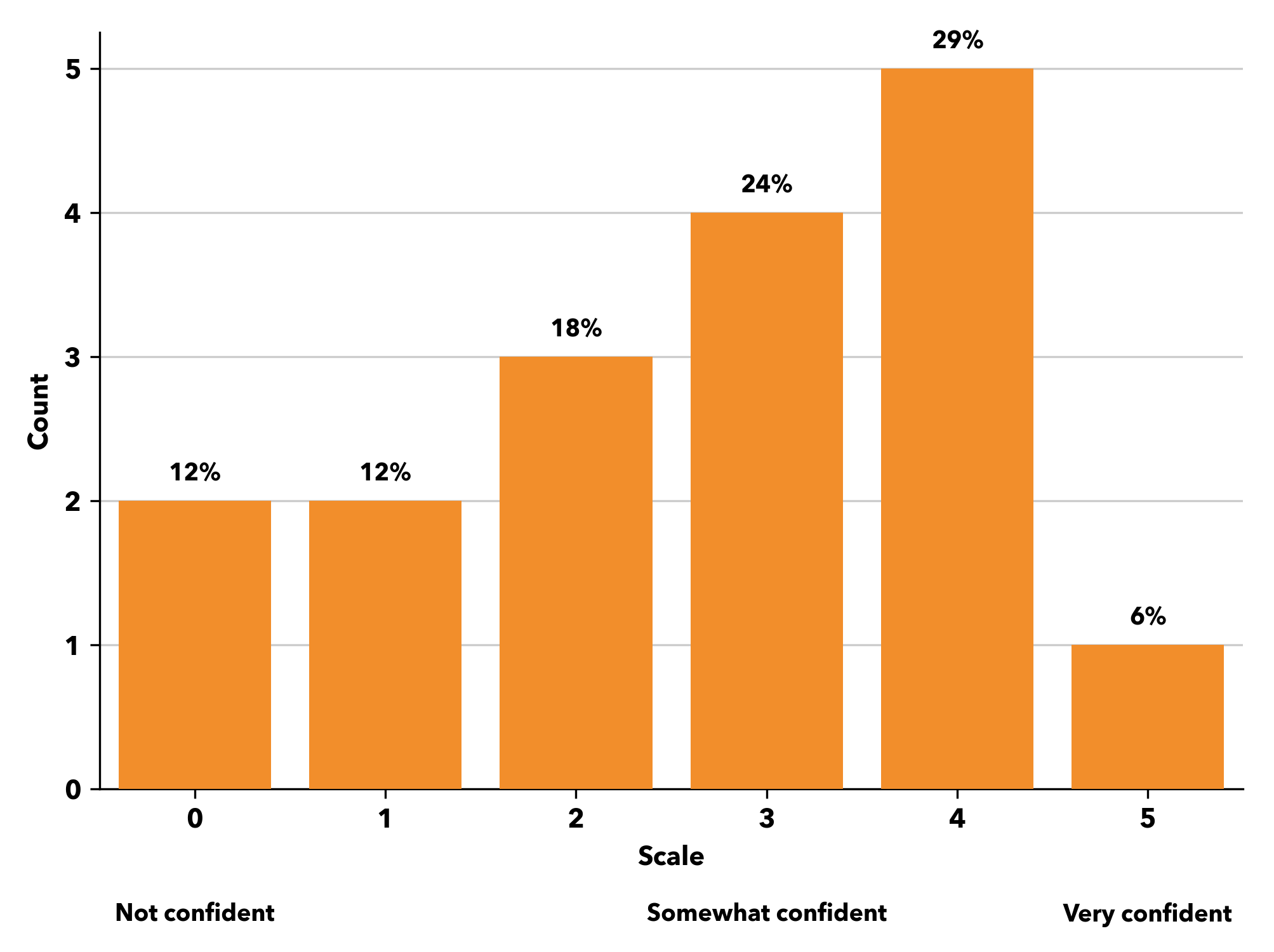
This visualisation illustrates confidence in understanding the role of a security trustee during a default. This question was only made available to respondents who said they would consider an investment type that might require a security trustee.
3.4.3 From your understanding, what are the core responsibilities of a security trustee?
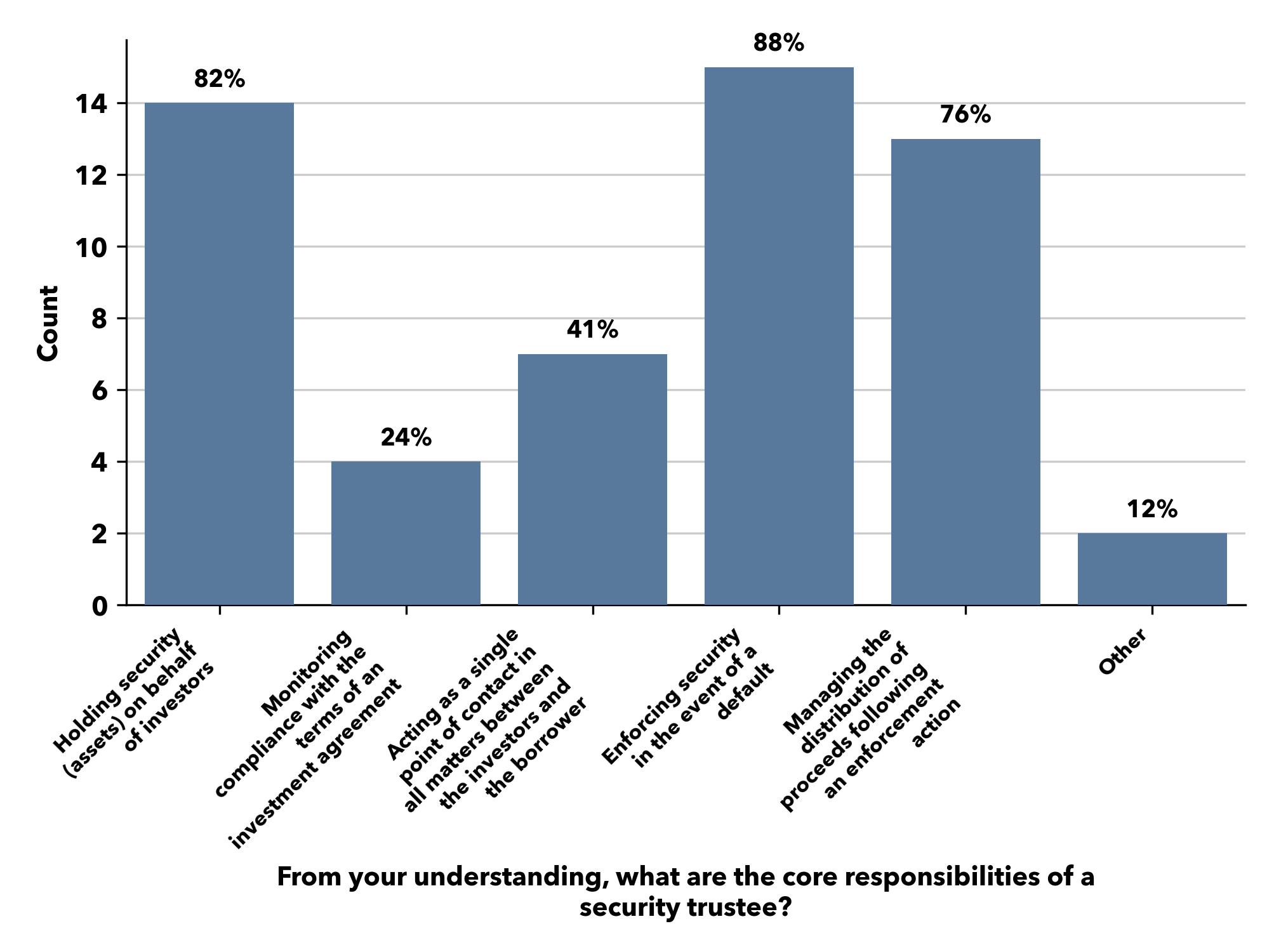
This chart shows which responsibilities are most commonly associated with security trustees by respondents. This question was only made available to respondents who said they would consider an investment type that might require a security trustee.
The two people who selected “Other” specified:
- “Acting to co-ordinate creditors and find consensus where needed”
- “Co-ordinating arrangement with receiver/administrator, registering position of those with a financial interest, communicating receiver/administrator materials to interested parties”
3.4.4 How important do you think it is for investors to understand the role and responsibilities of a security trustee?
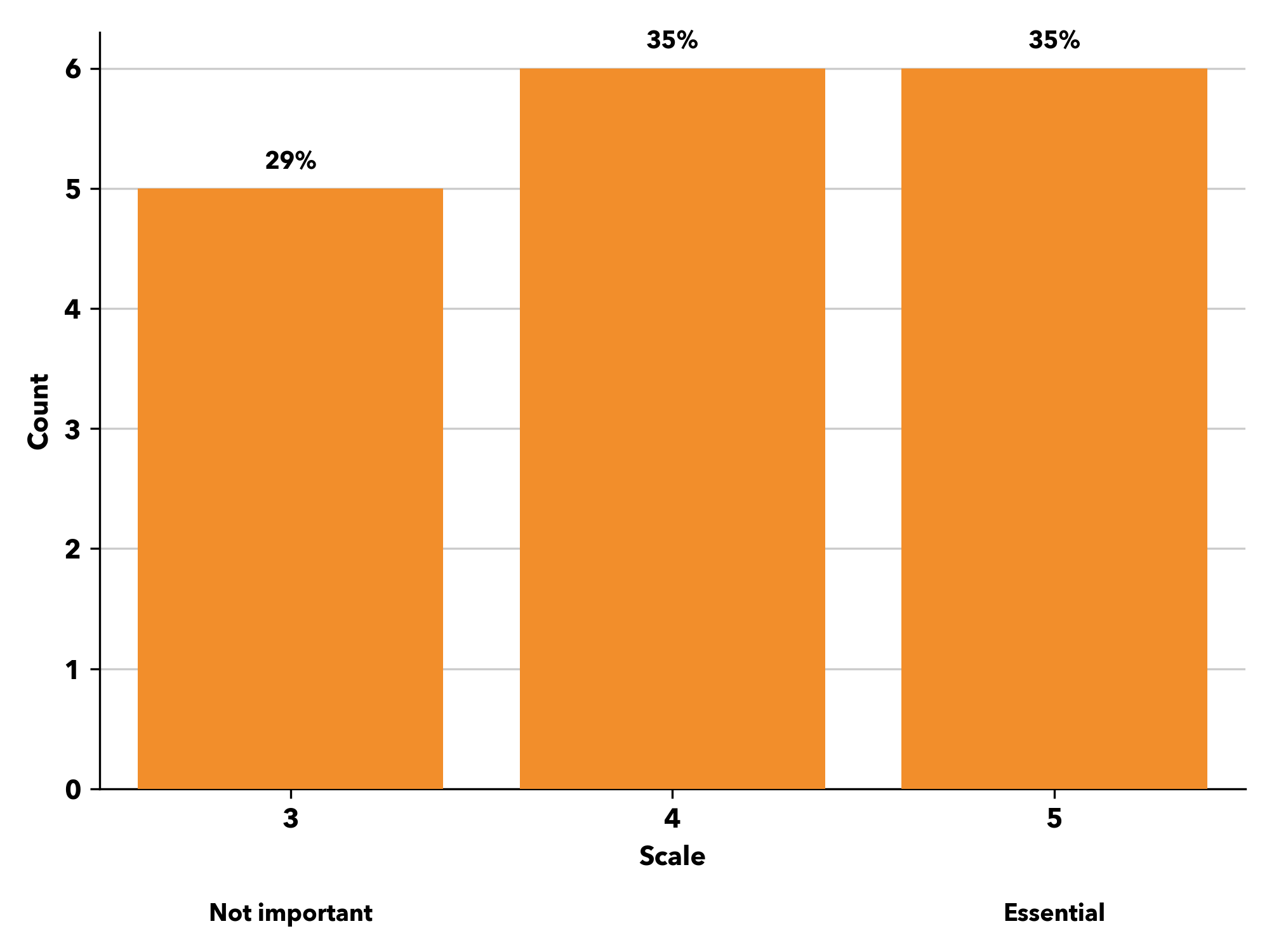
This visualisation highlights the perceived importance of investor understanding of security trustee roles. This question was only made available to respondents who said they would consider an investment type that might require a security trustee.
3.4.5 Has your organisation ever been involved in any social investments that require a security trustee?
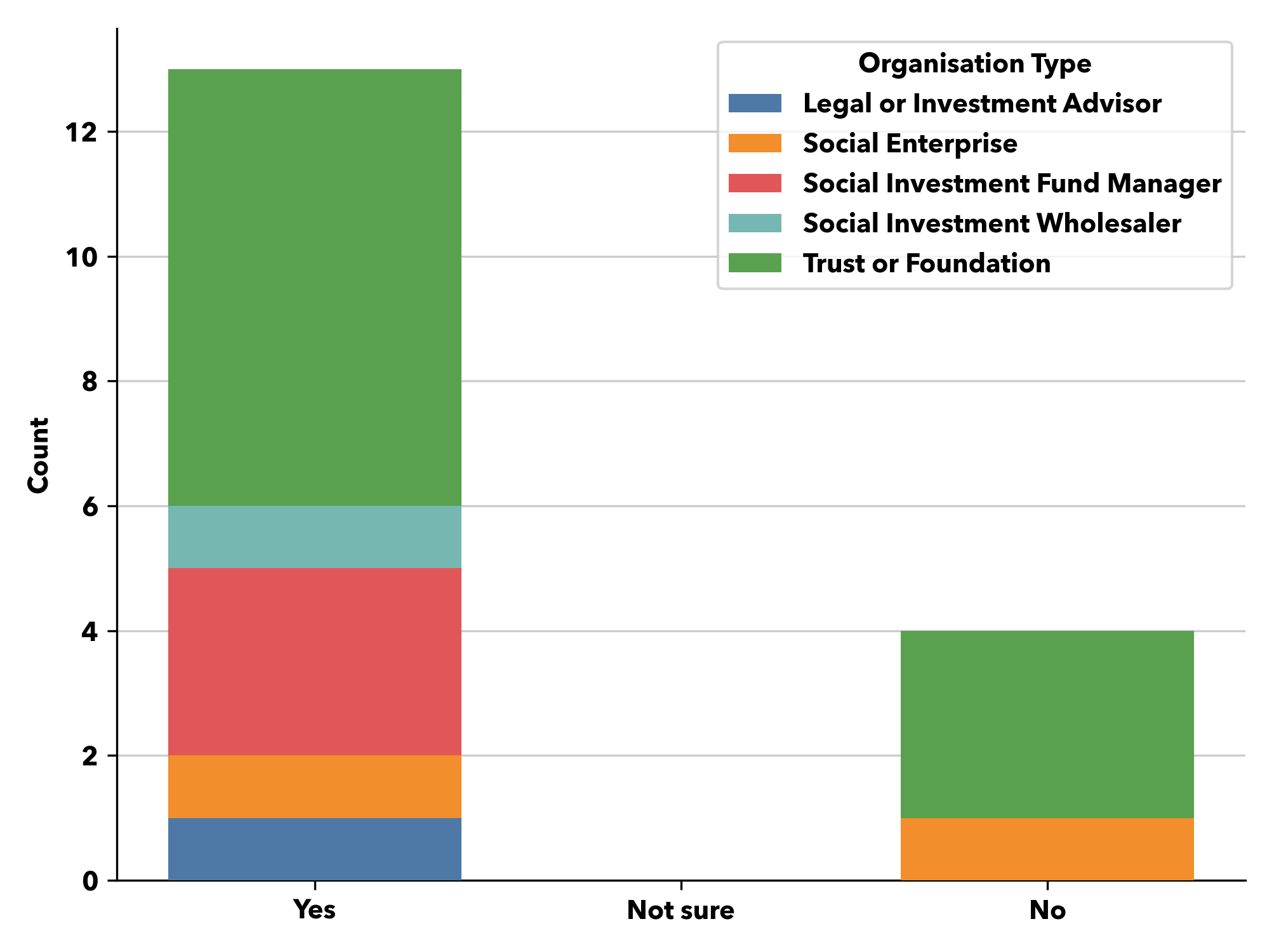
This question was only made available to respondents who said they would consider an investment type that might require a security trustee.
The actual question asked differed slightly depending on the type of organisation responding (investor, investee, advisor). The questions each faced were: “Has your organisation ever held, or does it currently hold, any social investments that require a security trustee?”, “Has your organisation ever issued any social investments that require a security trustee?”, and “Has your organisation ever advised on any social investments that require a security trustee?”.
3.4.6 If yes, who was appointed to the role of security trustee?
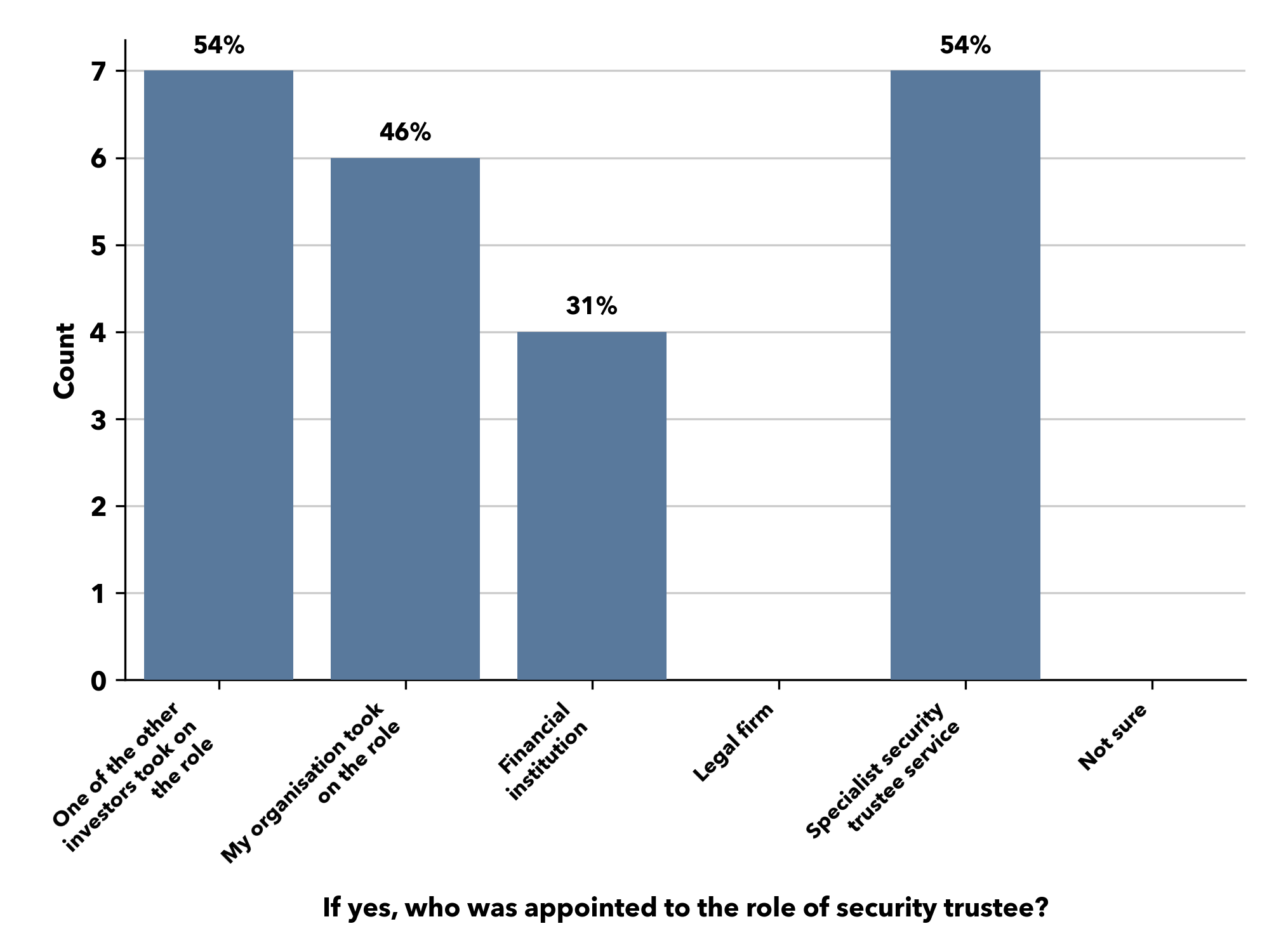
This visualisation shows who typically takes on the role of security trustee in practice. This question was only made available to respondents who said they had been involved in a social investment that required a security trustee. Respondents could select multiple answers.
3.4.7 What type of social investment was it that required a security trustee?
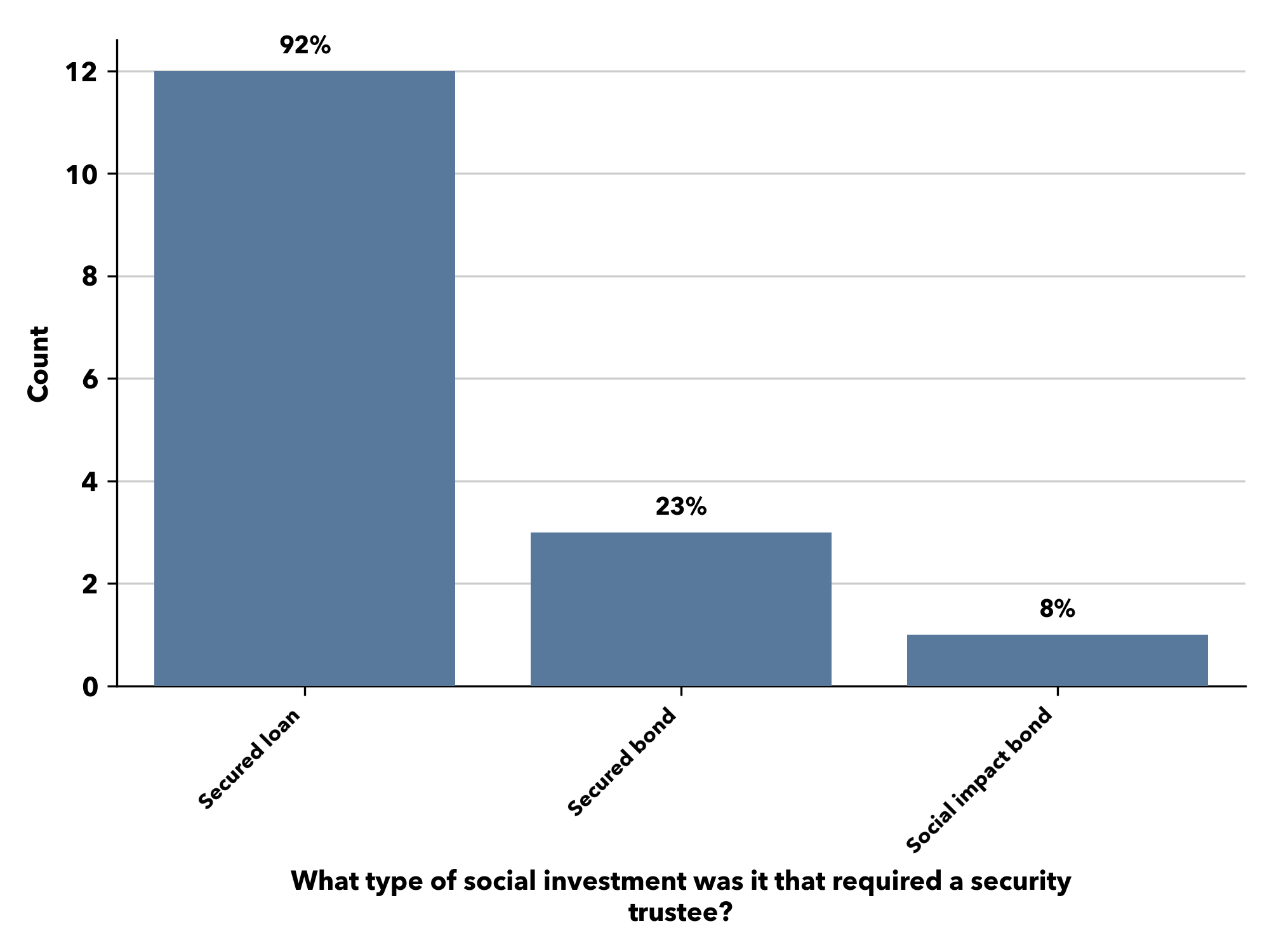
This chart displays the types of investments that most often require a security trustee. This question was only made available to respondents who said they had been involved in a social investment that required a security trustee.
One respondent who selected “Other” specified “Debt with junior and senior lenders”.
3.4.8 What sort of assets formed the majority of the security?
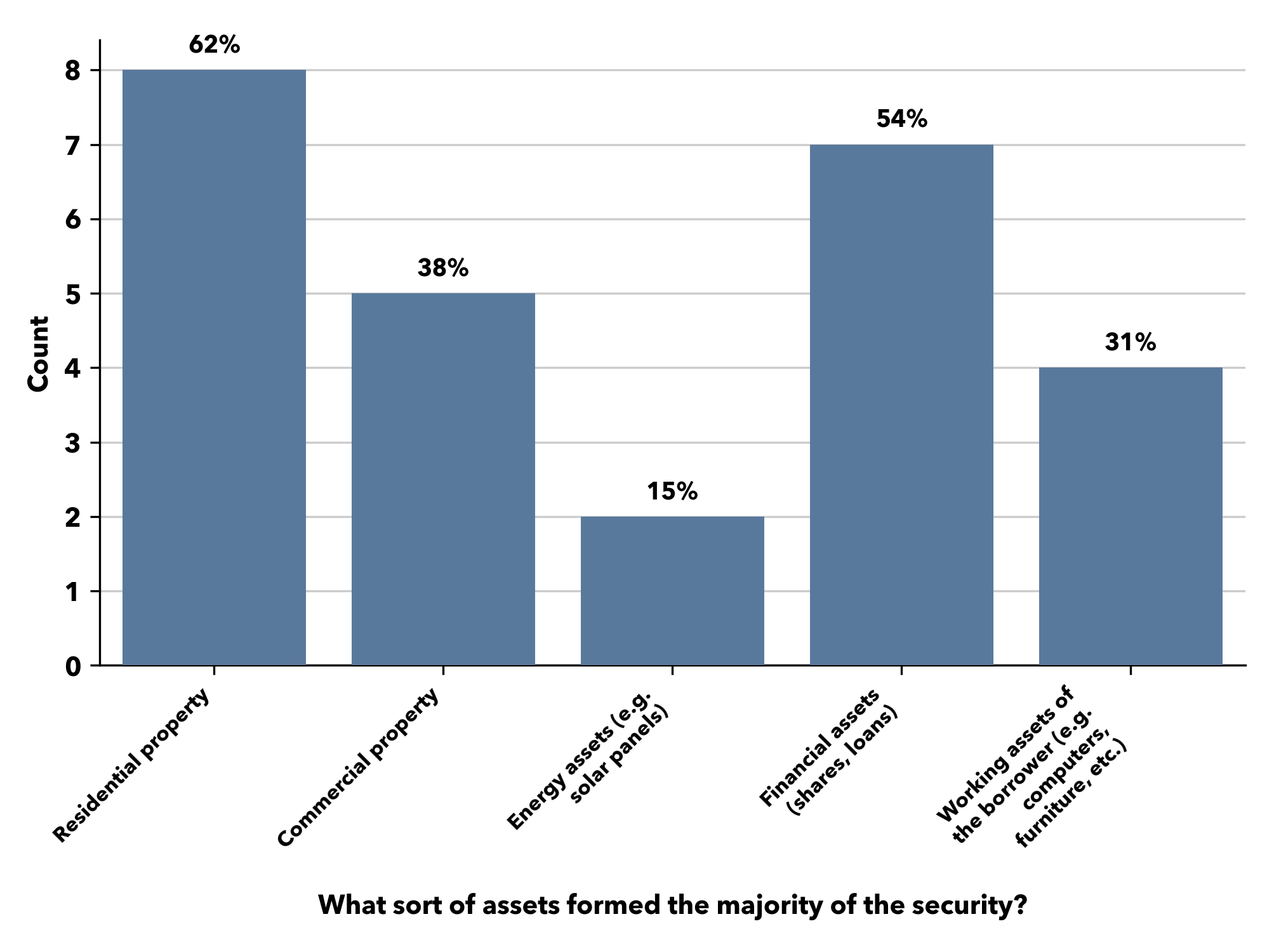
This visualisation shows the types of assets most commonly used as security. Respondents could select multiple answers. This question was only made available to respondents who said they had been involved in a social investment that required a security trustee.
3.4.9 Have you, or your organisation, ever experienced a situation where a security trustee was required to act on behalf of investors in the event of a default?
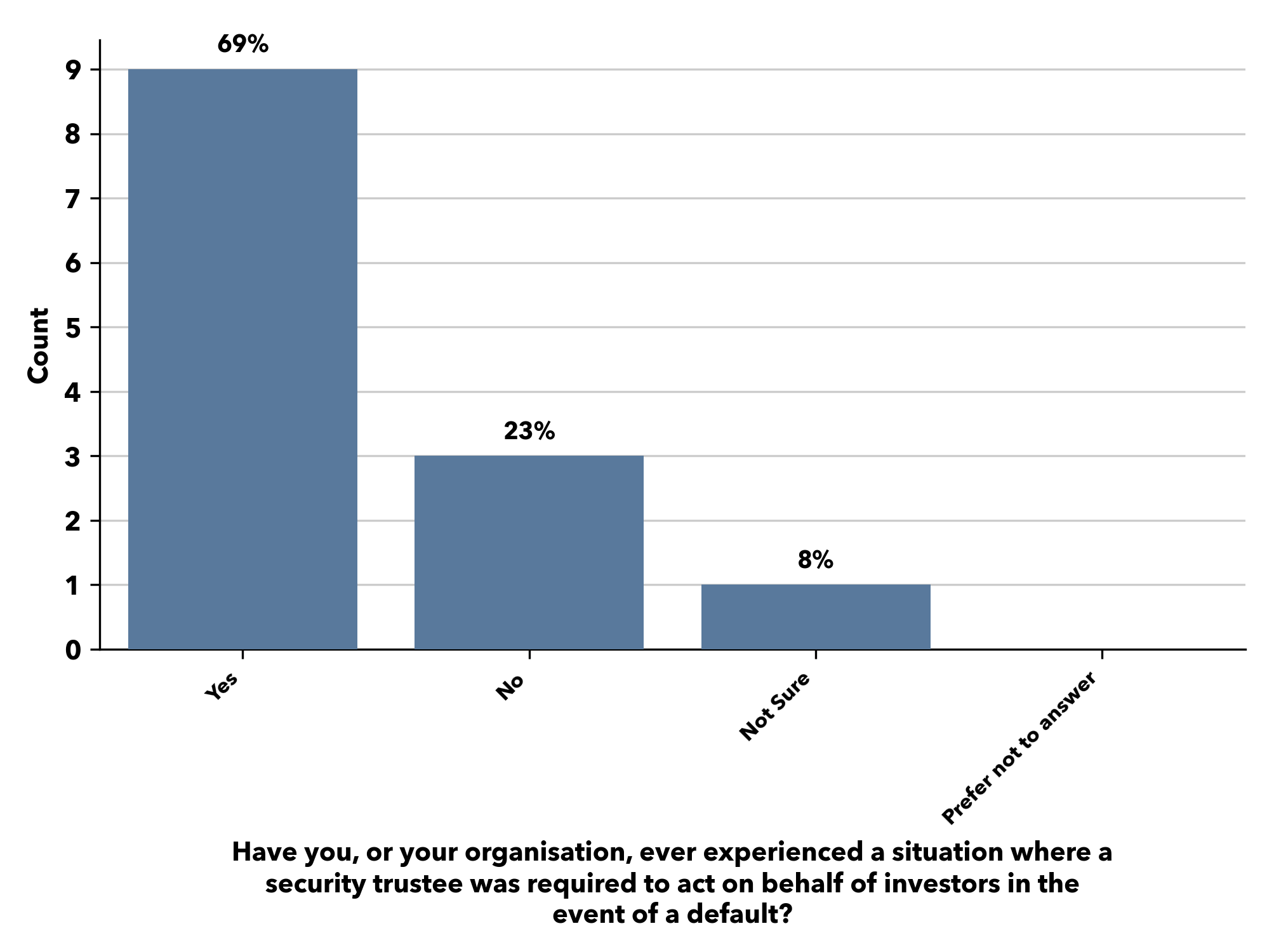
This chart shows the frequency of default scenarios requiring security trustee action. This question was only made available to respondents who said they had been involved in a social investment that required a security trustee.
3.4.10 How did you find the experience working with the security trustee in a default scenario?
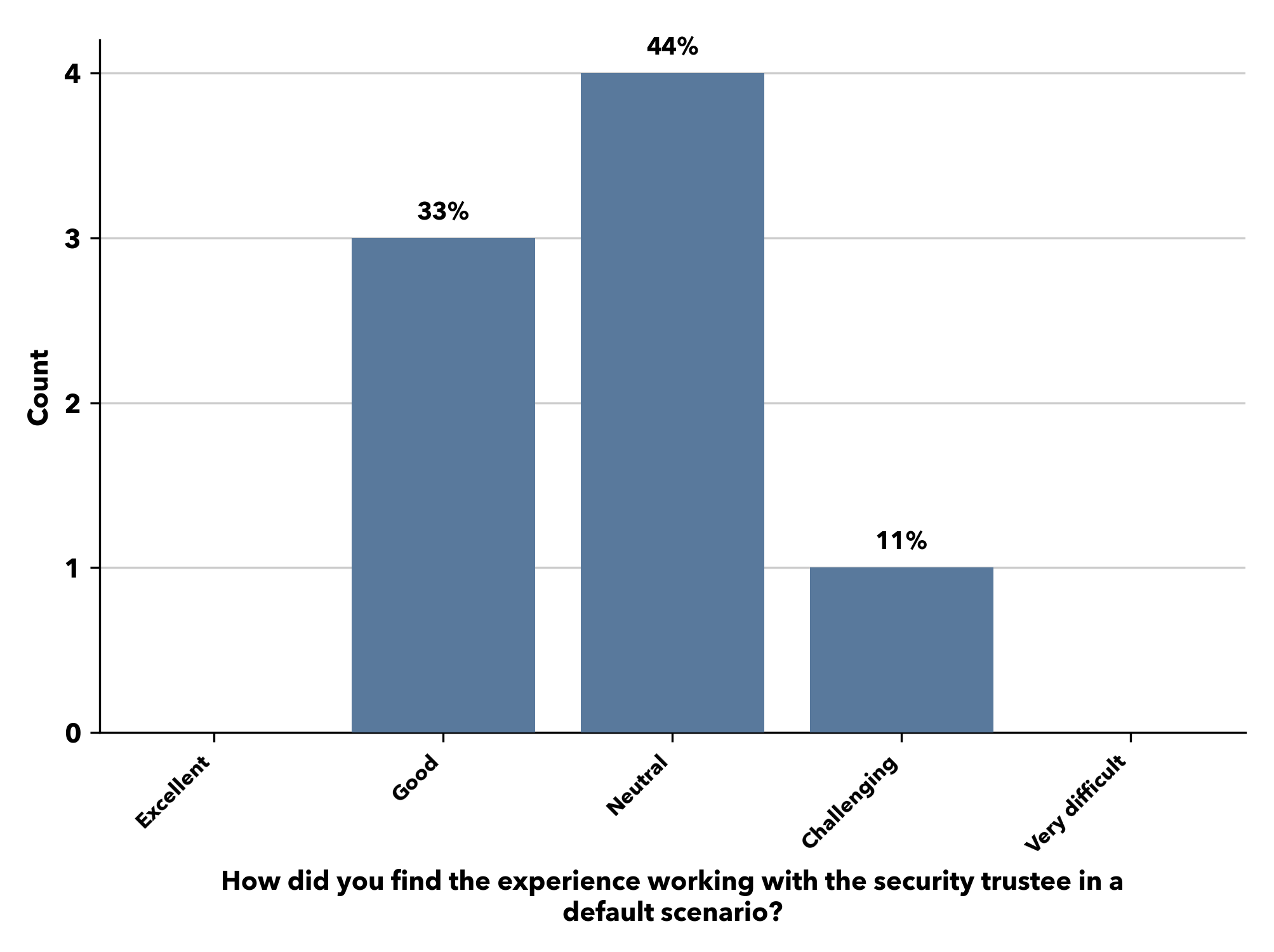
This visualisation displays respondent satisfaction with security trustee performance in default scenarios. This question was only made available to respondents who said they had experiences a situation where a security trustee was required to act.
3.5 Security trustee preferences
3.5.1 Who would be your preferred option to take on the role of security trustee in a social investment?
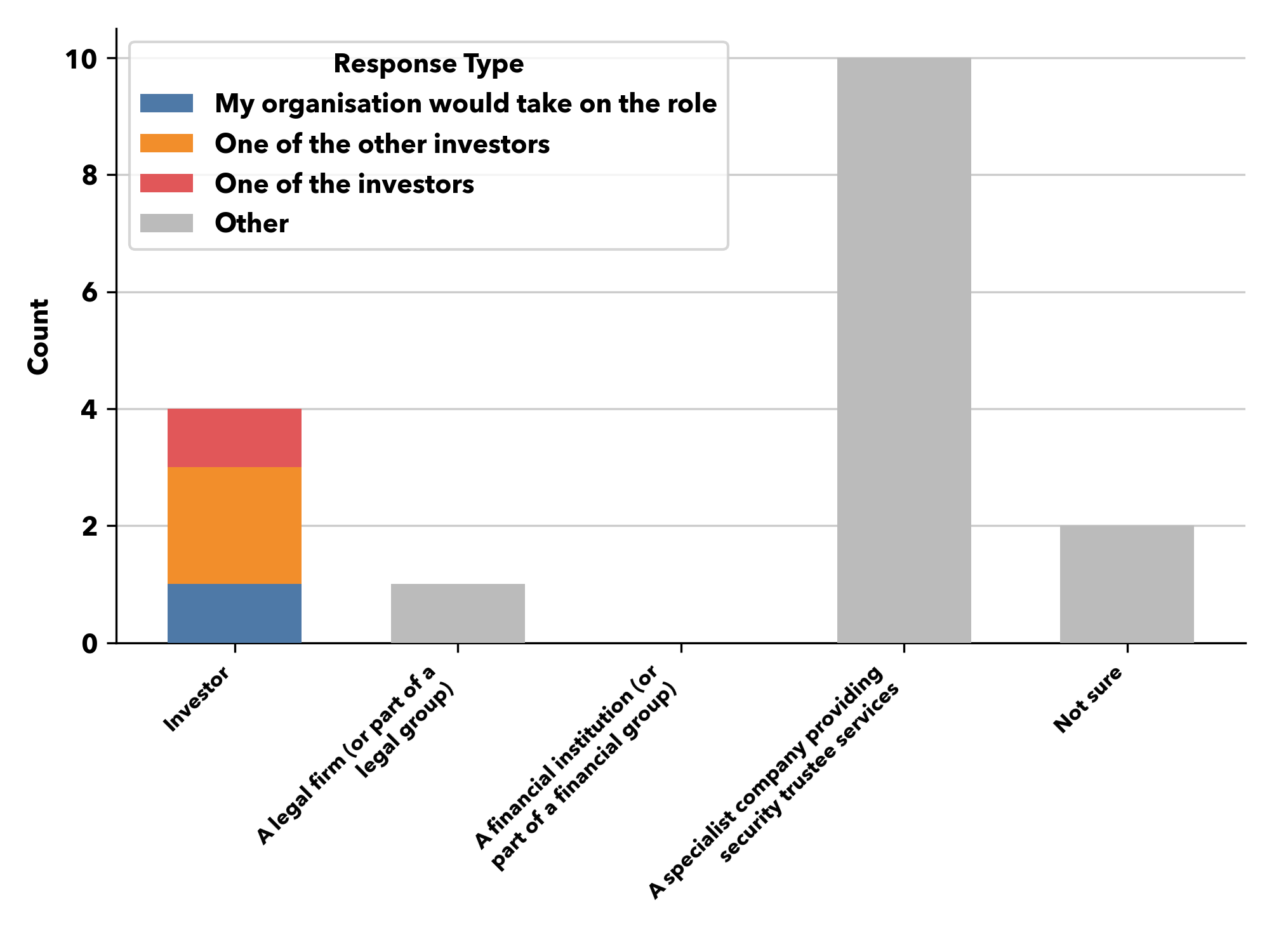
This chart shows preferences for who should act as security trustee. This question was only made available to respondents who said they would consider an investment type that might require a security trustee. Potential investors were given the option to distinguish between taking the role on themselves, or it being done by a different investor.
3.5.2 What attributes do you think are the most important for a security trustee in a social investment scenario?
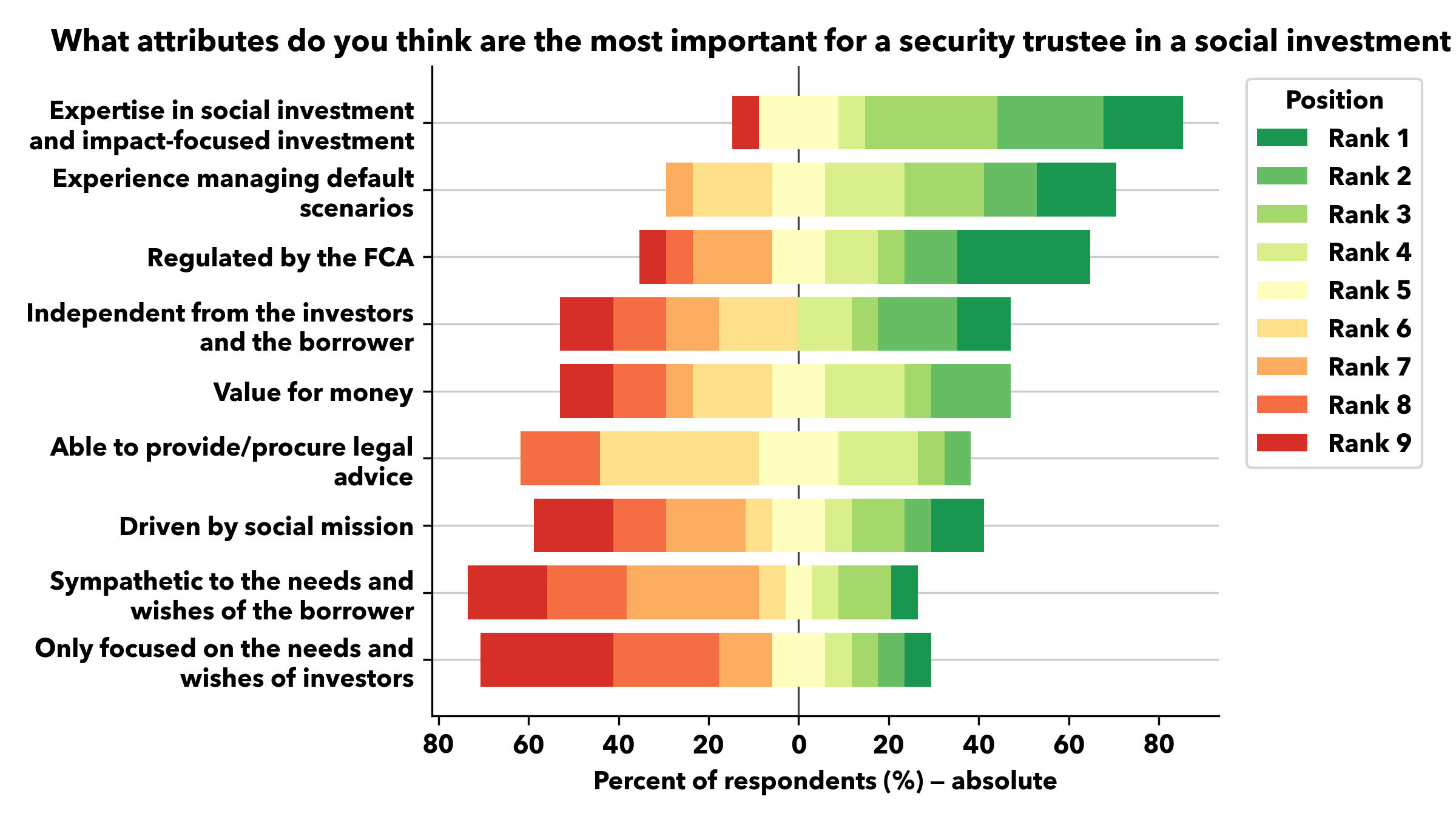
This visualisation displays the attributes ranked most important for security trustees. This question was only made available to respondents who said they would consider an investment type that might require a security trustee.
It takes a moment to understand what this type of diagram is showing. We asked people to rank at least the top 3 attributed they felt a security trustee should have. They could rank more if they wished. The chart shows how often each attribute was ranked in each position, offset into those ranked above 5 and those ranked below. It highlights that the three most desired attributes are “Expertise in social investment and impact-focused investment”, “Experience managing default scenarios”, and “Regulated by the FCA”.
3.5.3 In the event of a default, where would you place the balance between social impact and financial return?
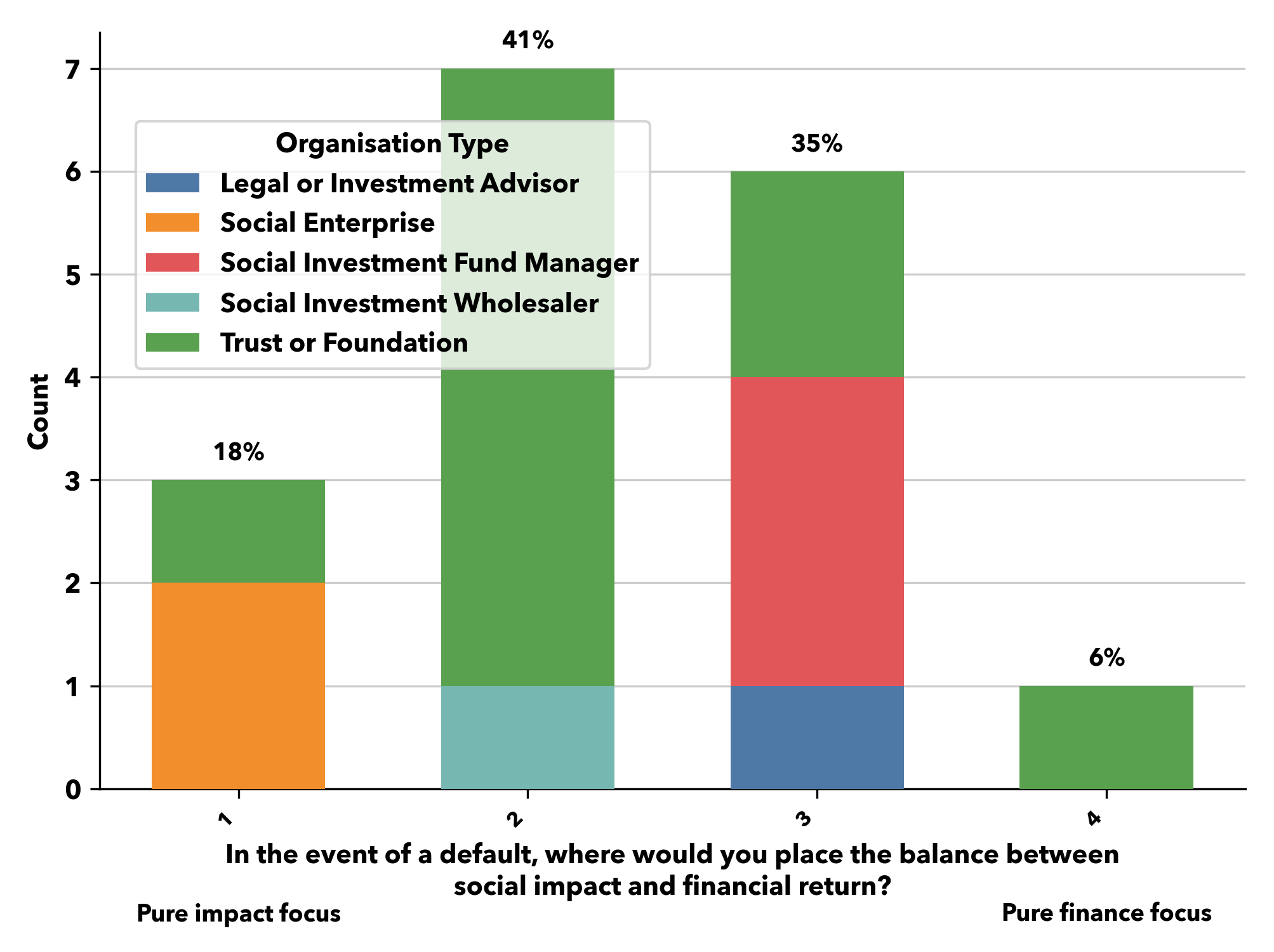
This chart shows respondent views on balancing social impact and financial return in default scenarios. This question was only made available to respondents who said they would consider an investment type that might require a security trustee.
3.5.4 In the event of a default, where would you place the balance between borrower priorities and investor priorities?
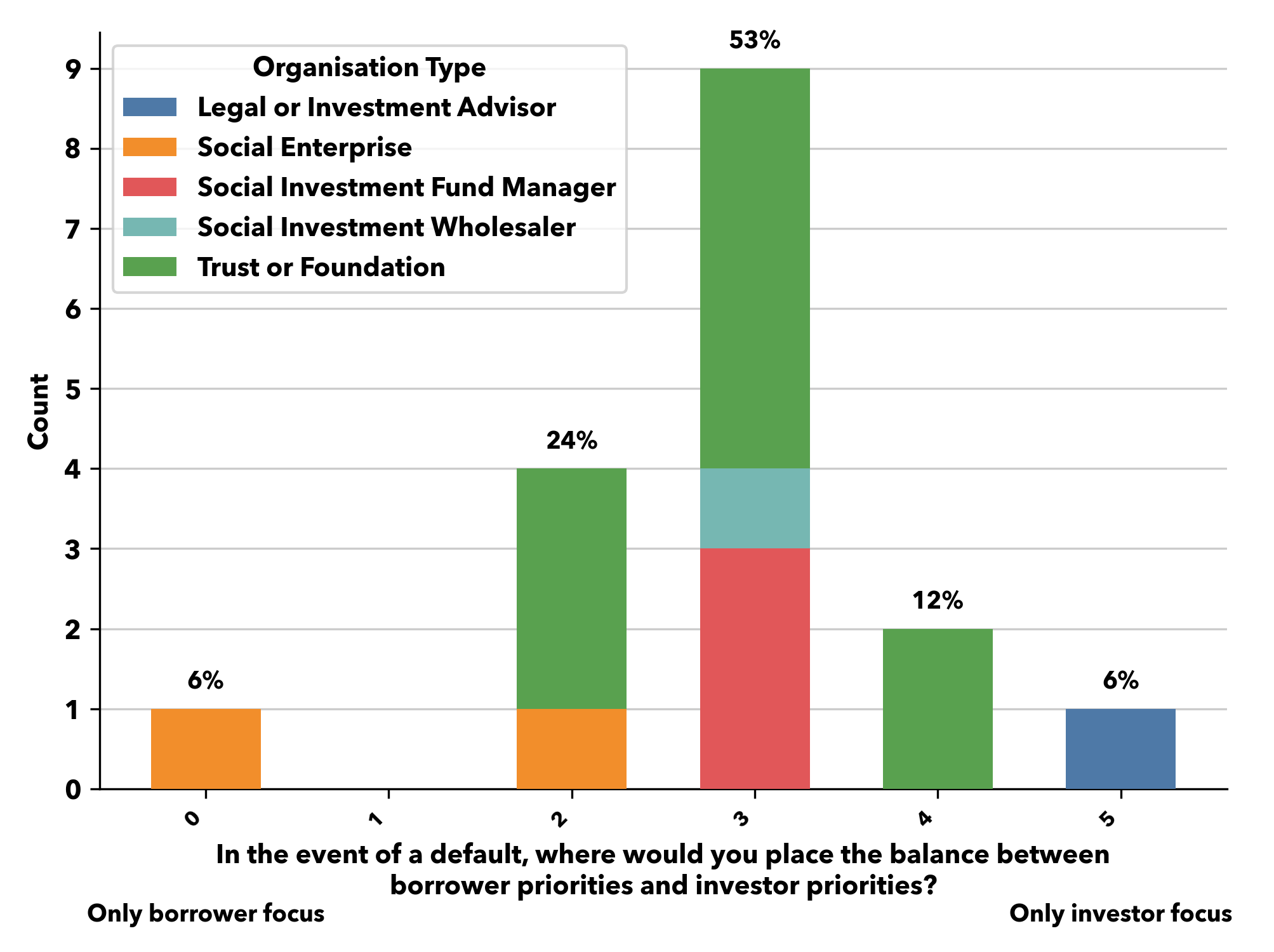
This visualisation illustrates how respondents balance borrower and investor priorities in default situations. This question was only made available to respondents who said they would consider an investment type that might require a security trustee.
3.5.5 Do you think there is a need for a specialist security trustee service that understands the UK social investment market and the balance between the financial and social interests of investors and borrowers?
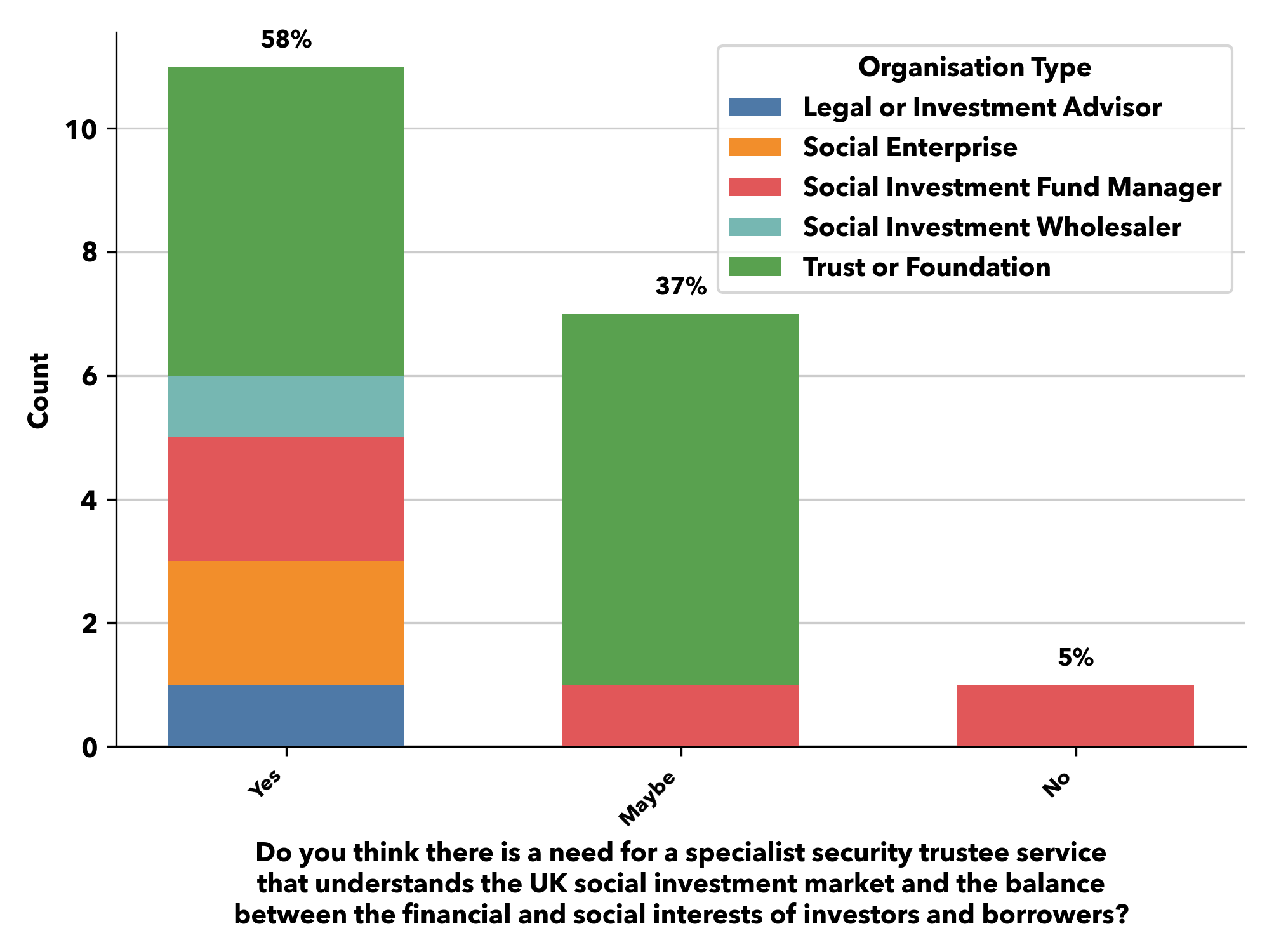
This chart shows the perceived need for a specialist security trustee service.